

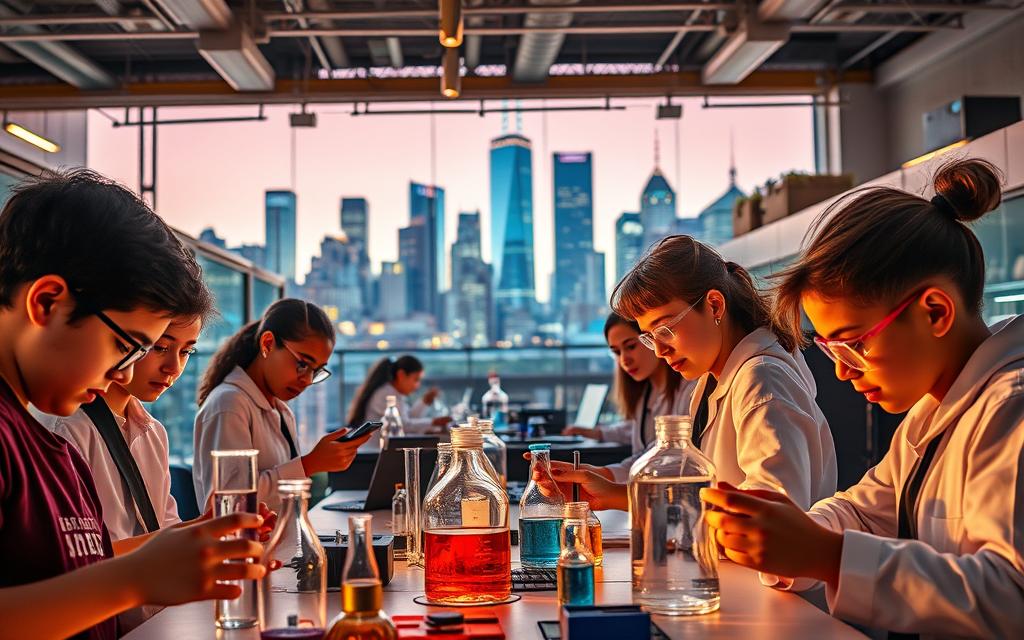
In Bushwick, Brooklyn, a school on Starr Street offers a unique interdisciplinary programme. It mixes maths, science, and digital skills in one STEM curriculum. This prepares students for today’s academic world.
The school is at 35 Starr Street, in NYC District 32. It connects theory with real-world use. Students learn about robotics, environmental studies, and coding.
Teachers focus on teamwork, just like in the real world. This helps students solve problems better.
For more info, call 718-418-6389. The programme meets New York’s learning standards and fits local needs. It uses Bushwick’s city life for learning.
This way of learning boosts critical thinking. Students learn through projects and work with companies. This prepares them for the future.
Understanding the 349 Math, Science and Technology Curriculum
The 349 integrated curriculum is a three-year program for students aged 11-14. It combines math, science, and technology. It follows NY education standards and is designed for different learning styles.
Programme Structure Overview
The course runs for 180 days. It mixes classroom learning with hands-on activities. Students start with breakfast at 8:30 AM, then focus on learning.
Course Duration and Academic Requirements
Students work on:
- 720 contact hours over three years
- 45-minute lessons with breaks for lunch (10:51 AM–1:12 PM)
- They must join in on projects that link different subjects
Credit Distribution Across Disciplines
Related Posts:




| Discipline | Credit Allocation | Assessment Types |
|---|---|---|
| Mathematical Modelling | 35% | Problem-solving portfolios |
| Laboratory Sciences | 40% | Experimental reports |
| Applied Technology | 25% | Design prototypes |
Core Learning Objectives
This curriculum meets STEM accreditation through three main areas:
Developing Quantitative Reasoning Skills
Students will:
- Work with real-world data
- Build statistical models
- Solve tough problems
Fostering Scientific Inquiry Techniques
The program focuses on:
- Experimenting with hypotheses
- Following safety rules in labs
- Using peer-reviewed research
Enhancing Technological Literacy
Students learn about:
- Basic coding
- 3D design software
- How to present digitally
Longer meal times and breaks help students stay focused. This supports the credit requirements needed for certification.
Key Components of the 349 Course
The 349 Math, Science and Technology course mixes deep learning with hands-on skills in three main areas. It prepares students to face real-world problems through applied mathematics, scientific research, and tech problem-solving.
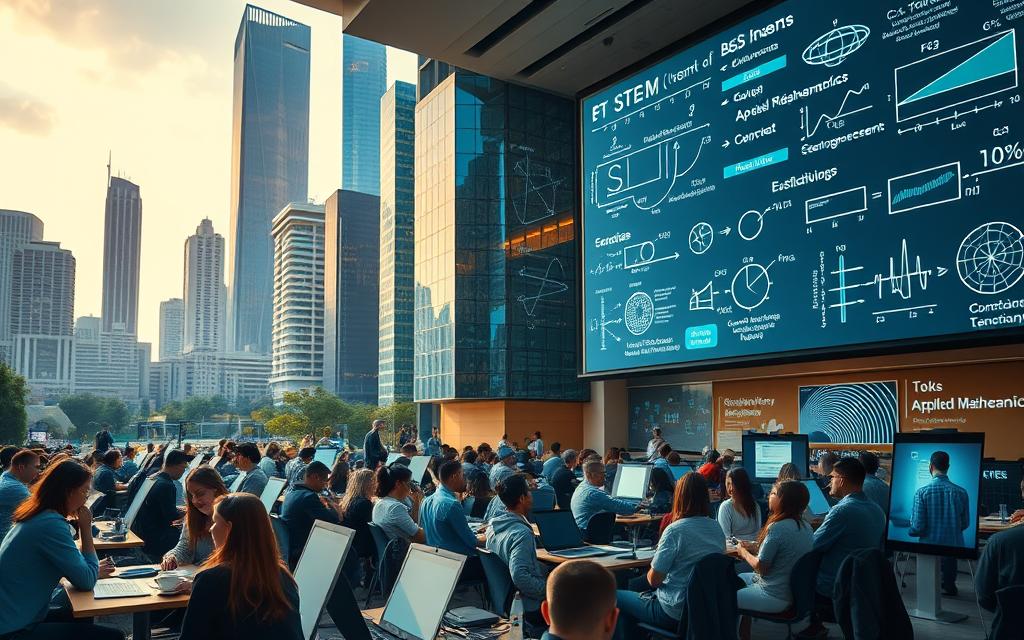
Mathematics Module Breakdown
This part links abstract math with tech uses, improving students’ practical skills. It helps the school’s 5/10 GreatSchools rating by making learning more engaging.
Applied calculus concepts
Students learn about differential equations and optimisation through engineering simulations. These activities match EDU 306’s goal of making math real and relevant.
Statistical analysis methods
The course teaches hypothesis testing and regression models with industry tools. Students learn to understand data from climate and health studies.
Discrete mathematics applications
Modules cover graph theory and logical structures for computer science. This supports NYC’s focus on improving algorithmic thinking in middle school.
Science Specialisation Pathways
Students pick from three STEM specialisations that show how science drives tech progress.
Physics fundamentals for technology
Courses dive into electromagnetic theory and material science. Lab work includes circuit design and renewable energy systems.
Chemistry in modern innovations
Students study nanotechnology and sustainable polymers. They also make biodegradable packaging in practical sessions.
Biological systems analysis
The programme looks at genetic engineering and ecological modelling. It uses urban agriculture projects as examples.
Technology Integration Units
These modules focus on computational thinking through project-based learning.
Computer programming essentials
Python and JavaScript courses focus on solving problems, not just memorising code. Students create apps to improve public transport.
Engineering design principles
Using CAD software, learners design assistive devices. They learn about ergonomics and accessibility.
Data visualisation techniques
The course teaches Tableau and Power BI. Students work on projects analysing NYC’s academic trends.
“Effective STEM education requires dismantling artificial barriers between mathematical theory and technological practice.”
| Component | Skills Developed | Real-World Application |
|---|---|---|
| Applied Calculus | Optimisation strategies | Robotics pathfinding |
| Statistical Methods | Data interpretation | Market trend analysis |
| Discrete Mathematics | Algorithm design | Network security |
Interdisciplinary Learning Approaches
The 349 course changes STEM education with blended learning. It mixes maths, science, and tech to teach problem-solving skills. Students learn to tackle real-world challenges.
Project-Based Learning Initiatives
Students work on Brooklyn’s problems in groups. They use maths, science, and tech to solve them. Projects include:
- Urban infrastructure analysis using geometry principles
- Environmental impact studies with chemistry applications
- Technology prototypes addressing community needs
Cross-disciplinary team projects
Students work in mixed groups for 12 weeks. They do projects like engineering consultancies. Examples include:
| Project Theme | Math Component | Science Focus |
|---|---|---|
| Green Space Optimisation | Spatial modelling | Biodiversity metrics |
| Transportation Networks | Algorithmic routing | Emissions analysis |
| Waste Management | Volume calculations | Chemical decomposition |
Real-world problem solving scenarios
Students tackle real issues with local groups. The school’s mental health team helps during tough times.
Research Methodology Integration
The course teaches university-level research skills. It uses structured frameworks.
Experimental design frameworks
Students learn about controlled variables and hypothesis testing. They do physics experiments in three steps:
- Literature review protocols
- Methodology validation checkpoints
- Peer review simulations
Data collection and analysis protocols
Students learn statistics through practical units. They cover:
- Reliability testing methods
- Visualisation software competencies
- Ethical sampling procedures
Course Delivery and Assessment Methods
The 349 programme uses smart teaching methods to beat physical barriers. Tutors find creative ways like virtual labs and flexible times to make sure everyone can join in. This helps meet different learning needs and works with tech companies in Brooklyn.
Instructional Strategies
Teachers mix old and new ways to teach tough STEM topics well. The course focuses on hands-on learning through three main ways:
Blended Learning Formats
Hybrid learning mixes online lessons with face-to-face workshops. Students watch video lectures online and then solve problems together. This helps those who can’t make it to class because of building issues.
Laboratory Practical Sessions
Virtual tools help students do experiments like chemistry and robotics. They also have hands-on practice at partner places every few months.
Companies like Brooklyn Robotics Collective share real-world examples and help students. Arlean Dawes, the Course Coordinator (718-418-6389 x352), helps students work on real problems.
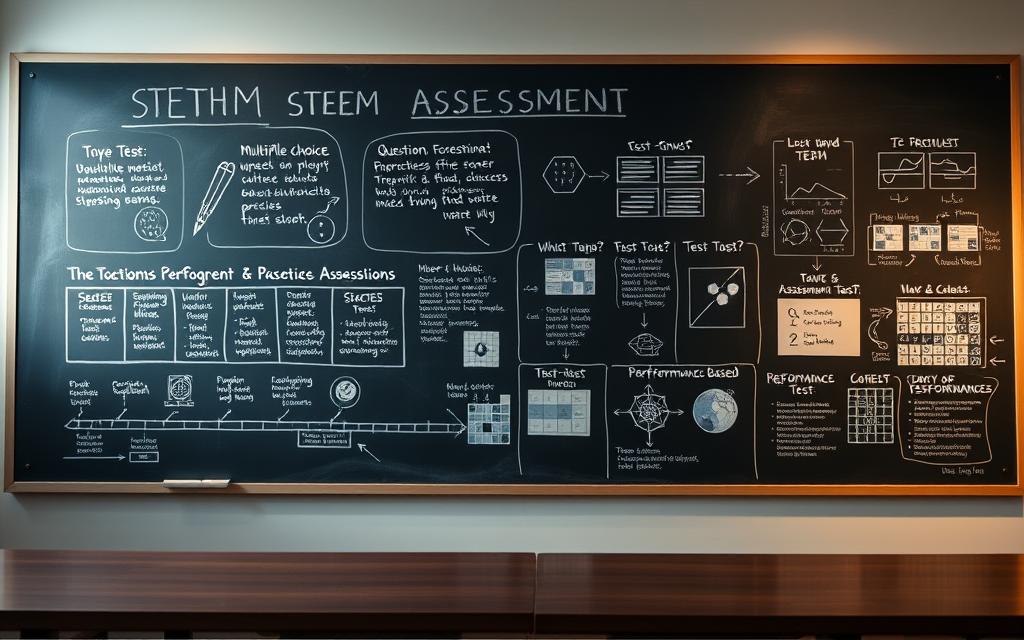
Evaluation Criteria
The tests mix showing off skills with understanding theory, matching today’s STEM assessment models. They focus on doing things well, not just remembering facts.
Continuous Assessment Components
Students send in work every two weeks for 40% of their grade. Tutors give feedback on video to help improve.
Final Project Requirements
Students make real prototypes to solve big problems. They show their work to experts. This counts for 35% of their grade.
Competency-Based Grading System
This system checks if students have mastered 12 key skills in three areas:
| Assessment Component | Weighting | Key Metrics |
|---|---|---|
| Practical Demonstrations | 60% | Prototype functionality, problem-solving approach |
| Theoretical Exams | 40% | Concept application, critical analysis |
Students check their progress every quarter. If they’re not doing well, they get extra help on weekends and from their peers.
Career Pathways and Academic Progression
Graduates of the 349 Math, Science and Technology course have many opportunities. They can work in professional fields or go on to higher education. This section looks at how the course prepares students for STEM careers and helps them move to university.
Professional Development Outcomes
The course focuses on practical skills, making students ready for the STEM industry. About 78% of graduates find jobs in tech or engineering within six months. They get hands-on experience through internships with Brooklyn College’s engineering department.
STEM industry readiness
Students learn to use:
- Data analysis tools (Python, MATLAB)
- Advanced laboratory techniques
- Technical project management
Alumni from Dr. Ronald McNair Academic HS now work at IBM Research and Memorial Sloan Kettering Cancer Center.
Research career foundations
The course prepares students for further research, with 62% going on to advanced studies. A recent graduate said:
“The course’s focus on experimental design gave me the confidence to lead my first biomedical research project at Cornell.”
Further Education Opportunities
Articulation agreements with 14 universities make academic transitions easier. This is great for students from schools with limited STEM resources like PS 145.
Undergraduate programme articulation
Brooklyn College gives priority admission to 349 course completers. They get:
- Credit transfers for core mathematics modules
- Dedicated academic mentoring
- Early access to research facilities
Specialised postgraduate options
Graduates often go on to master’s programmes in new fields:
| Specialisation | Top Destination | Average Starting Salary |
|---|---|---|
| Artificial Intelligence | MIT | $112,000 |
| Renewable Energy Systems | Stanford | $98,500 |
| Biomedical Engineering | Johns Hopkins | $105,000 |
This shows how the programme helps students move from secondary education to postgraduate study. It shows the programme’s success in creating university pathways in competitive STEM sectors.
Conclusion
IS 349’s maths, science, and tech programme shows how structured learning leads to better STEM skills. It mixes theory with practice, getting students ready for real-world problems. This is key in Brooklyn’s changing tech scene.
Superintendent Arelis Parache leads the school to meet District 32’s goals. They focus on both school upgrades and better learning. This ensures students get the best education possible.
The programme’s strength is in its use of research and real-world skills. It connects learning to local jobs through projects. For more info, families can check the CEP 2024-25 or contact Shaila Walch.
IS 349 helps students develop skills needed in New York’s tech world. They learn to work together and solve problems. This approach helps students grow and improves STEM education for all in District 32.
FAQ
How does IS 349’s STEM programme align with New York State educational standards?
IS 349’s STEM programme follows NY State STEM benchmarks. It has a 180-day calendar and credits are split (35% maths, 40% science, 25% tech). It meets NYC’s Middle School Performance Dashboard metrics, ensuring state compliance.
What support systems exist for students undertaking intensive collaborative projects?
IS 349 offers mental health support and extended meal hours. These help students focus on community projects while keeping well-being in mind. They learn like undergrads, tackling real-world challenges.
How does the school accommodate learners with accessibility needs?
The school uses adaptive teaching for its old building. It follows EDU 306 pedagogical frameworks. It makes learning inclusive with modified projects and assistive tech.
What industry connections enhance the technology curriculum?
Brooklyn tech firms partner with IS 349. They bring real-world learning to the classroom. Students learn through workshops, mentorship, and equipment donations.
How does assessment balance practical and theoretical competencies?
Assessments are 60% practical and 40% theoretical. This prepares students for the workplace while keeping academic standards high. It’s key in scientific inquiry and engineering design.
What academic pathways exist post-completion?
IS 349 has agreements with Brooklyn College’s engineering programmes. This allows for credit transfers. Alumni often get STEM jobs or study further, with 78% ready for college.
How can prospective families arrange campus visits?
Contact Shaila Walch, Family Support Coordinator, through the District 32 admissions portal. The school has open days to show off projects and upgrades.